Super Ace 2, and the one thing it adds
Which one · sequel against original, from the maker's own two pages
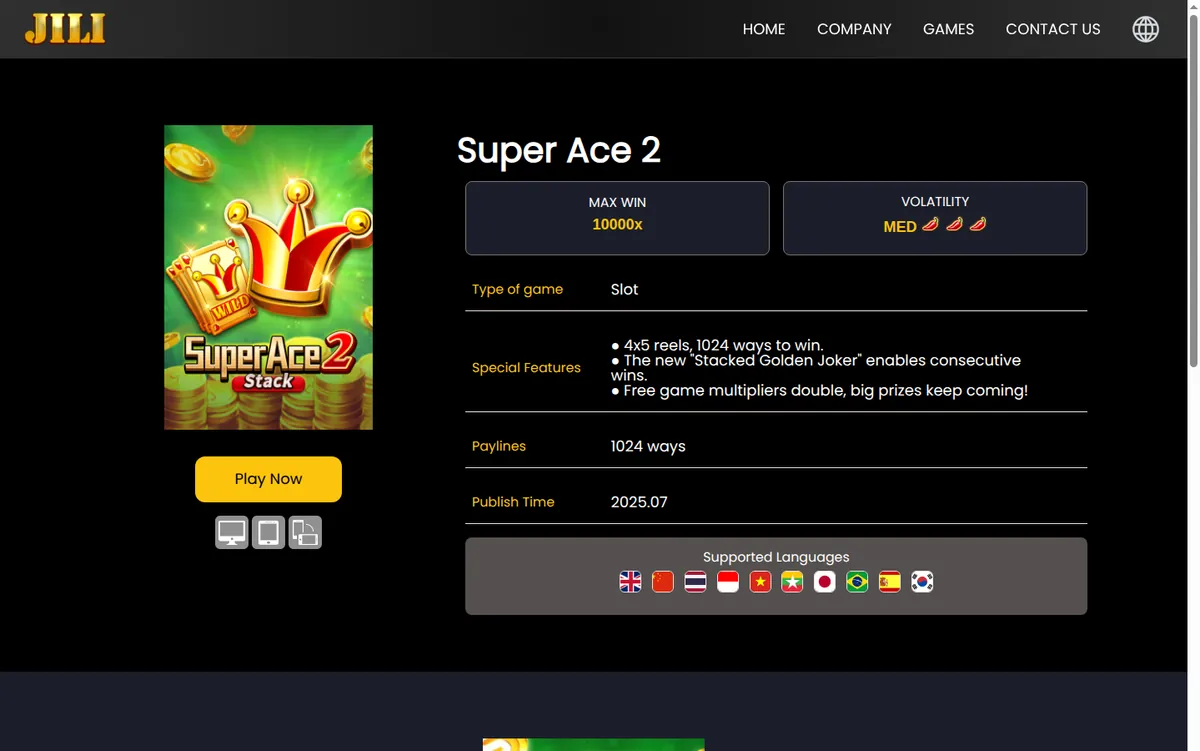
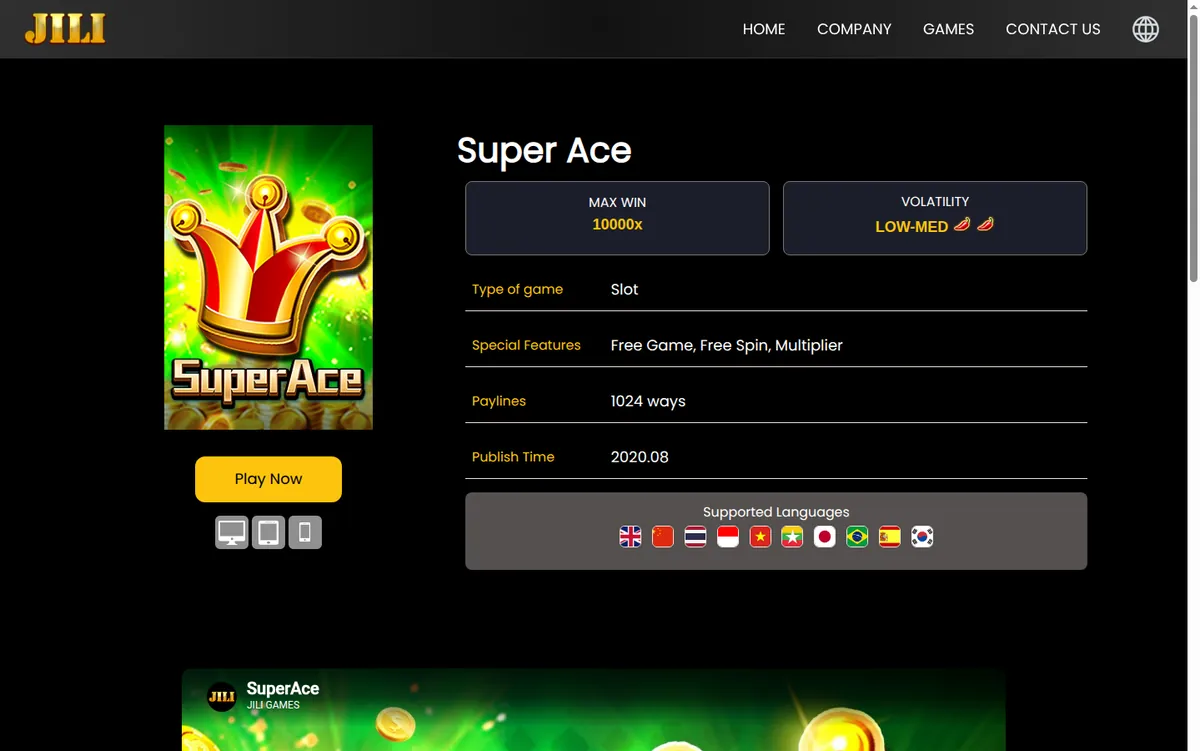
Five years separate them. The ceiling is identical, the grid is identical, the paying structure is identical. What the sequel adds is a stacked golden joker, and what it costs for that is a step up in volatility. Both figures come from JILI's own catalogue, which is the only place they agree with themselves.
The two entries, side by side
Both from JILI's own catalogue, read on 24 September 2026.
| Super Ace | Super Ace 2 | |
|---|---|---|
| Published | August 2020 | July 2025 |
| Max win | 10,000x | 10,000x |
| Volatility | LOW-MED | MED |
| Grid | 4×5 | 4×5 |
| Paylines | 1024 ways | 1024 ways |
| Named feature | golden card → joker in place | stacked golden joker |
Four rows out of six are identical. That is the honest headline: this is a tuning change and a feature addition, not a new game.
What the sequel adds
JILI's own summary of Super Ace 2 lists three things, and the middle one is the change:
- 4×5 reels, 1024 ways to win
- The new “Stacked Golden Joker” enables consecutive wins
- Free game multipliers double
The first and third are true of the original too. The second is not.
In the original, the loop works like this: a golden card sits on reel 2, 3 or 4, takes part in a win, and on elimination flips into a single joker occupying the space it vacated. That joker then bridges the next cascade. The whole mechanic is worked through on the golden card.
Stacked means the joker is not confined to one cell. More than one position fills at once, which is why the maker's phrasing is that it enables consecutive wins — a stacked wild is harder for the next drop to strand.
The company's own Chinese-language description says the same thing more directly: the original's golden-poker mechanic is retained, and the sequel adds the stacked golden joker so that eliminations can run consecutively on the board.
What it costs: the volatility line
This is the part worth slowing down for, because it is the only figure that moves in the wrong direction.
The original is published at LOW-MED. The sequel is published at MED.
Same ceiling, higher variance. In plain terms: the money arrives less evenly. A mechanic that keeps chains alive longer produces bigger chains when they happen and, necessarily, longer stretches when they do not. The ceiling did not rise to pay for that — 10,000x in both — so the trade is entirely in the shape of the distribution.
Whether that is an improvement depends on what you are after, and the honest answer is that it is a preference, not a ranking. A steadier game and a lumpier game with the same maximum are two products, and the maker's own two-letter volatility field is the only published statement of the difference.
What did not change
The ceiling. 10,000x in both. Note that the figure repeated across most English write-ups for the original — 1,500x — does not match either entry. That and three other disagreements are set out on RTP and max win.
The board. Four rows, five columns, 1024 ways in both.
The free game. Multipliers double inside it in both. The original's trigger and its buy button are covered on free spins.
Neither publishes an RTP. Not the original, not the sequel. JILI prints max win, volatility, features, paylines and a release date on both pages, and no return figure on either.
The five years in between
Worth knowing, because it explains why a lobby is confusing.
Super Ace came out in August 2020. Super Ace 2 came out in July 2025. In the gap, JILI shipped Super Ace Deluxe and Super Ace Scratch (both July 2024) and Super Ace Joker (March 2025). After the sequel came 3 Super Ace (March 2026) and Super Ace SPEED (June 2026).
So Super Ace 2 is not the second Super Ace game. It is the fifth, and it is the first to be numbered. The full list with every published parameter is on eight of them, and it contains one title paying a maximum of 375x and one that is not a slot at all.
Which to open
If you want the mechanic in its cleanest form, the original. It is the one whose rules screen states the reels-2-3-4 constraint plainly, the one with the four-step ladder, and the one this site's other pages describe.
If you have played the original and want the same game with longer chains and a rougher ride, the sequel.
Both are free to try, with no account, from the maker's own site — the free demo sets out how, and fifteen minutes in both settles the question better than any comparison table, this one included.
What any of it costs when the money is real is a separate question, and safer play is the page for it. The overview is at the original, read from the maker's pages.