The free demo, and where it actually lives
The game · free, first-party, no account
About thirty thousand searches a month in the Philippines are looking for a free Super Ace. Almost all of them land on an operator sign-up. The maker runs its own demo, on its own domain, with play credits already loaded — and this page is how to get to it, what it looks like when it works, and the one thing it cannot teach you.
The maker’s own free version
Play Super Ace for nothing, on JILI’s own server
- No accountno email, no registration, no operator
- No depositplay credits are already in the balance
- Nothing to installit runs in the browser tab
- 30–40 secondsthe first load is slow; a black frame is normal
Opens in a new tab on the maker’s site. Catalogue entry 49 is the 2020 original — the other seven games carrying this name have their own entries.
What the demo is
JILI publishes its games at its own site, and every catalogue entry carries two buttons: Game Info, which opens the parameter table, and Play Now, which opens the game.
Play Now is not a trailer. It loads the actual game from the maker's own game server with play credits already in the balance. No account, no email, no operator, no deposit, nothing to install. The reels behave exactly as they do anywhere else, because it is the same build.
That is unusual enough to be worth stating twice: the company that makes Super Ace gives the game away to try, for free, first-party, and almost none of the pages ranking for the phrase super ace demo mention it.
Getting there
The button above goes straight to entry 49. To get there by hand instead: the catalogue lives at jiligames.com, under Games, with a filter for slots. It returns more than eleven hundred titles, so use the browser's find rather than scrolling.
The thing to be careful about is which entry you open, because the name is shared by eight games — the original is catalogue entry 49, and the differences are set out on eight of them. Open Deluxe or Scratch by accident and the demo will work perfectly while showing you a different game from the one this site describes.

What it looks like when it is working
Four things happen in order, and knowing them saves you from closing the tab too early.
A logo and a bar. Thirty to forty seconds of loading under the JILI mark. The progress bar is honest but slow, and a black rectangle around the fifteen-second mark is part of it, not a failure.
A card of instructions. The game shows its own tutorial panel before the reels: a small board with wilds on it and one line of text explaining that after the golden poker wins it turns into a wild in the same place. That sentence is the game explaining its own core mechanic, and it is worth reading before dismissing it. There is a Continue button and a don't show next time underneath.
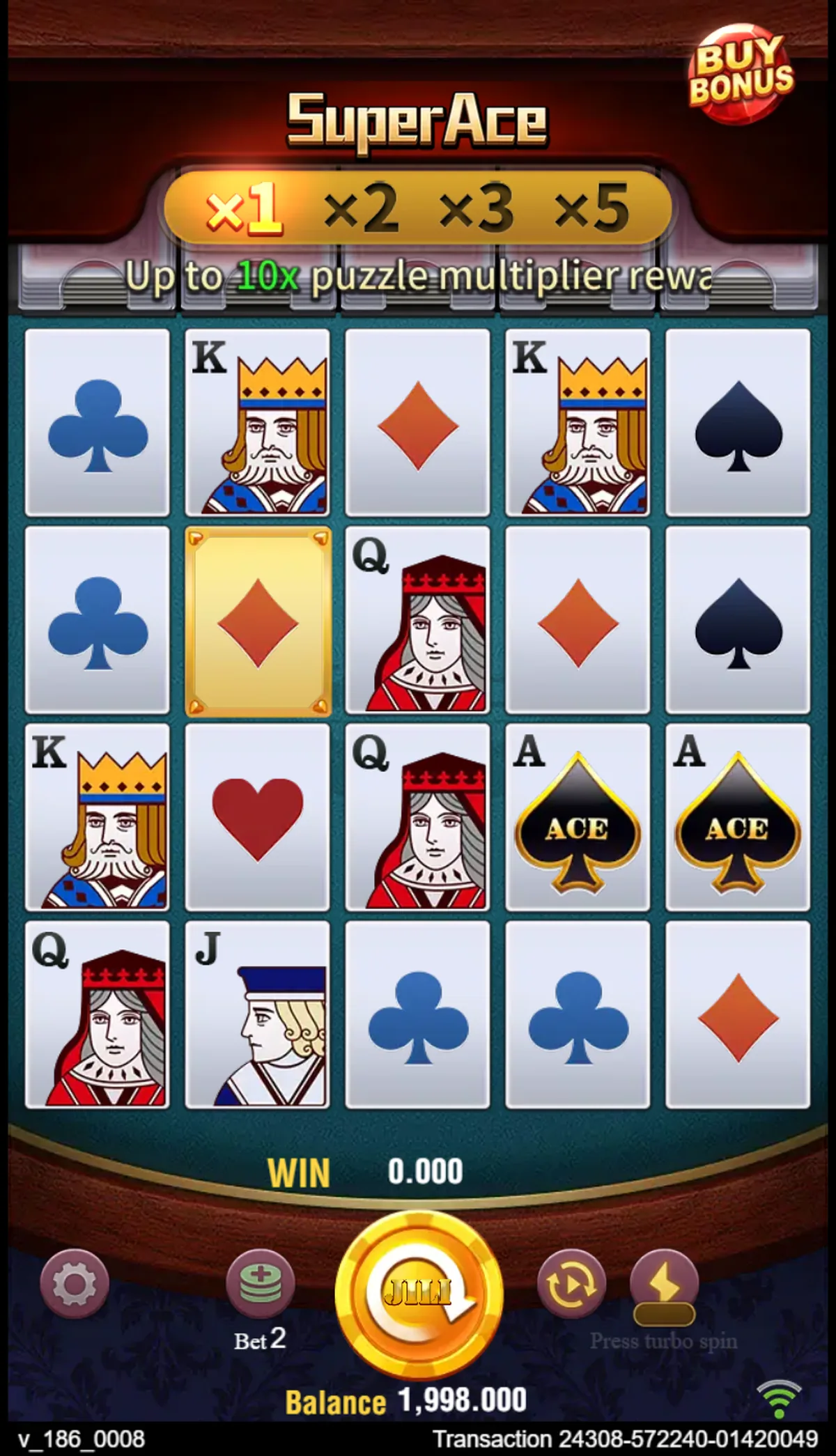
A title screen with PLAY. The multiplier ladder is already visible above the reels here — ×1 ×2 ×3 ×5 — before a single spin.
The game. Five columns, four rows, card faces from ace down through the picture cards and the four suits. Play credits in the balance, a bet value, a spin button, and a BUY BONUS badge in the top-right corner.
It opens portrait, and that is not a bug
The game is built for phones and renders as a tall rectangle regardless of how wide the window is. On a desktop you get the game in the middle and the loading artwork visible on both sides.
Nothing is broken and there is no setting to change it. It is worth knowing only because a portrait game in a landscape window reads as a layout failure, and people close it.
The side menu, and the one button worth pressing
During play there is a small strip on the left edge with three icons. The middle one is an i.
That opens the game's own rules and paytable — the maker's text, not a summary of it. It is where the constraint that decides the whole game is written down: the golden card appears only on reels 2, 3 and 4. That sentence is the reason the golden card has a page of its own.
The rules screen is also slow to render — a few seconds of black under its own header — for the same reason the game is.
Write down the build number
In the bottom-left corner of the game screen there is a small string. On the run these pages were written from it read v_186_0008, on 24 September 2026.
That matters more than it looks. A slot gets updated. A page describing a mechanic that changed two builds ago is wrong in a way that is invisible unless somebody wrote down which build they were looking at. If something here does not match your screen, compare that string first — and note that almost no page about this game prints one at all, which is its own kind of answer about how those pages were written.
What a demo cannot do
This is the honest limit, and it is not small.
The demo runs the same reels with the same rules and the same maths. What it does not have is consequence. Play credits reset, a bad run costs nothing, and a good one settles nothing. Every decision you make in it is made by a person who cannot lose, which is not the person who plays for money.
That is worth being blunt about, because free play is often described as practice. It is practice for the buttons. It is not practice for the part that actually decides how the evening goes, and there is no way to practise that for free.
What the demo is genuinely good for: checking that a claim on some page is true. The bonus-buy button either exists on screen or it does not. The ladder either reads ×1 ×2 ×3 ×5 or it reads something else. The golden card either appears on the outer reels or it never does. Ten minutes in the demo settles arguments that whole articles get wrong — including, as set out on RTP and max win, several of the most repeated figures about this game.
If the demo will not load
Three things go wrong, in descending order of likelihood.
It is still loading. Give it a full minute before deciding.
The tab went to sleep. A background tab can have its rendering throttled while a game is downloading. Bring it to the front and reload.
Wrong entry. A catalogue number that is not 49 loads a different game perfectly well. Check the title on the loading screen — it names itself.
After the demo
The demo is the whole game with nothing at stake, which is the best possible way to learn the mechanic and a poor way to decide anything about money. If the next step is real money, it happens at a casino and not here — this site runs no game and takes no bet, and the reasons for that division are on who writes this.
If the reason you were looking for a demo was that an installer looked like the easier route, the demo is the answer to that too — a browser game needs no download, and what those searches actually lead to is set out on the app searches.
Before that step, two pages are worth ten minutes each: free spins, because the buy button is the fastest way to spend money in this game, and safer play, because a limit set on a good day is the only setting that works on a bad one.
Why almost no page ranking for this game points at the maker's own free version is set out on in the Philippines.
The rest starts at Super Ace Philippines.